
Class 5 Perimeter, Area & Volume Worksheets
In Class 5 Maths, the concepts of perimeter, area, and volume help students understand how to measure shapes in different ways. These ideas are useful in everyday life too. For example, when you measure the boundary of a garden, you are finding its perimeter. When you calculate how much space a playground covers, you are finding its area. And when you measure how much water a box or tank can hold, you are finding its volume.
Sometimes these topics may seem confusing at first. With clear explanations and step-by-step examples, students can easily understand how these measurements work. To strengthen learning, students can also practice regularly using Area, Perimeter and Volume Class 5 worksheets available on CBSEClassWorksheets, which provide structured exercises on perimeter, area, and volume for better understanding.
Practising these concepts regularly helps build a strong mathematical foundation for middle school helping students to improve their confidence and perform better in exams.
What is Perimeter?
Perimeter is the total length of the boundary of a closed shape.
If you walk around the edge of a field once, the distance you cover is the perimeter of that field.
Perimeter is measured in units such as cm, m, or km.
Example – Perimeter of an Irregular Shape
Consider a shape with the following sides:
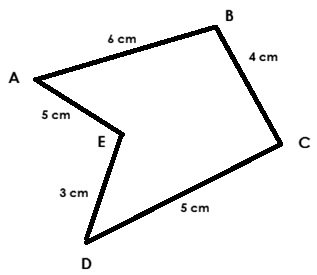
Perimeter of the figure = AB + BC + CD + DE + EA
= 6 + 4 + 5 + 3 + 5 cm
= 23 cm
Perimeter of a Square
A square has four equal sides.
Formula
Perimeter of a square = 4 × side
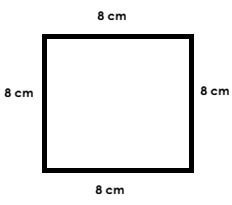
Example
Side of square = 8 cm
Perimeter = 4 × side
= 4 × 8
= 32 cm
So, the perimeter of the square is 32 cm.
Perimeter of a Rectangle
A rectangle has four sides and opposite sides equal.
Formula
Perimeter of rectangle = 2 × (Length + Breadth)
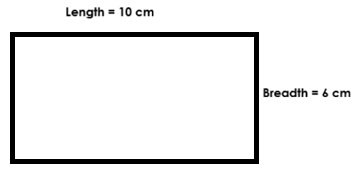
Example
Length = 10 cm
Breadth = 6 cm
Perimeter = 2 × (Length + Breadth)
= 2 × (10 + 6)
= 2 × 16
= 32 cm
So, the perimeter of the rectangle is 32 cm.
Perimeter of an Equilateral Triangle
In an equilateral triangle, all three sides are equal.
Formula
Perimeter = 3 × side
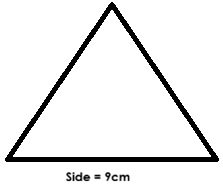
Example
Side = 9 cm
Perimeter = 3 × side
= 3 × 9
= 27 cm
So, the perimeter of the triangle is 27 cm.
What is Area?
Area is the amount of space inside a closed shape. For example, if you want to know how much space a floor covers for tiles or carpet, you are finding its area. Area is measured in square units, such as: cm², m²
Area of a Square
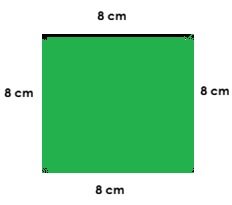
Formula
Area of square = side × side
or
Area = side²
Example
Side = 8 cm
Area = side × side
= 8 × 8
= 64 cm²
So, the area of the square is 64 square centimetres.
Area of a Rectangle
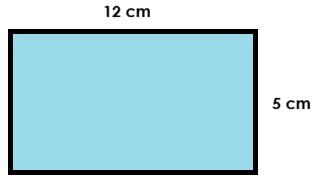
Formula
Area of rectangle = Length × Breadth
Example
Length = 12 cm
Breadth = 5 cm
Area = 12 × 5
= 60 cm²
So, the area of the rectangle is 60 square centimetres.
What is Volume?
Volume tells us how much space a 3-dimensional object occupies. It is used to measure how much something can hold, such as:
water in a tank
juice in a box
space inside a room
Volume is measured in cubic units, such as: cm³, m³
Example – Understanding Volume
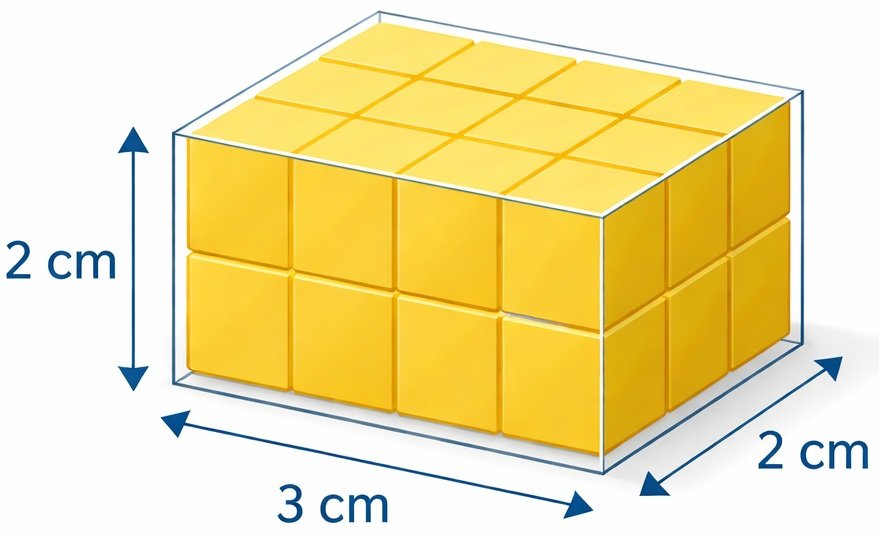
A box is filled with small cubes of 1 cm each.
If there are 3 cubes in length, 2 cubes in width, and 2 cubes in height, then
Total cubes = 3 × 2 × 2
= 12 cubic units
So, the volume of the box is 12 cm³.
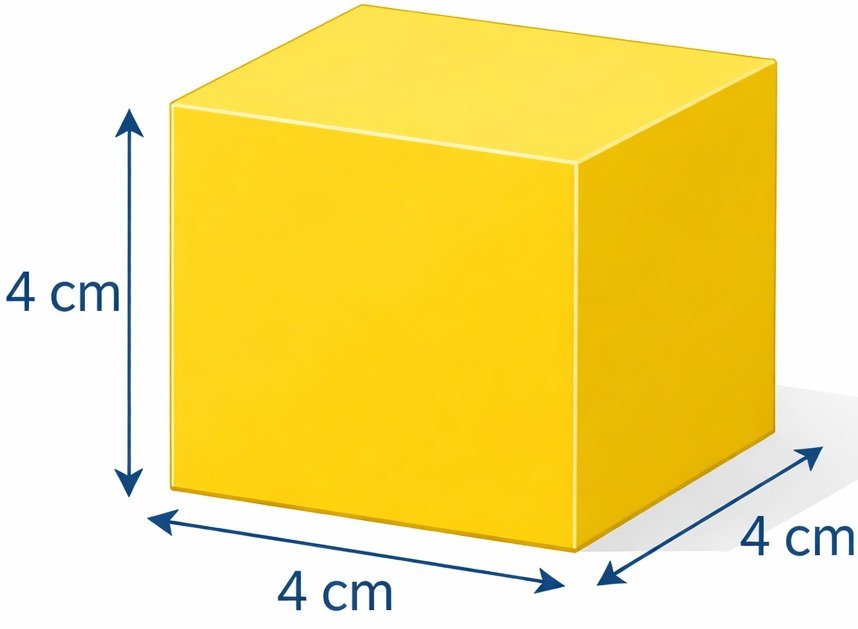
Volume of a Cube
A cube is a three-dimensional solid shape with six identical square faces (sides), 12 equal edges, and eight vertices (corners). A cube has all sides equal.
Formula
Volume of cube = side × side × side
or
Volume = side³
Example
Side = 4 cm
Volume = 4 × 4 × 4
= 64 cm³
So, the volume of the cube is 64 cubic centimetres.
Volume of a Cuboid
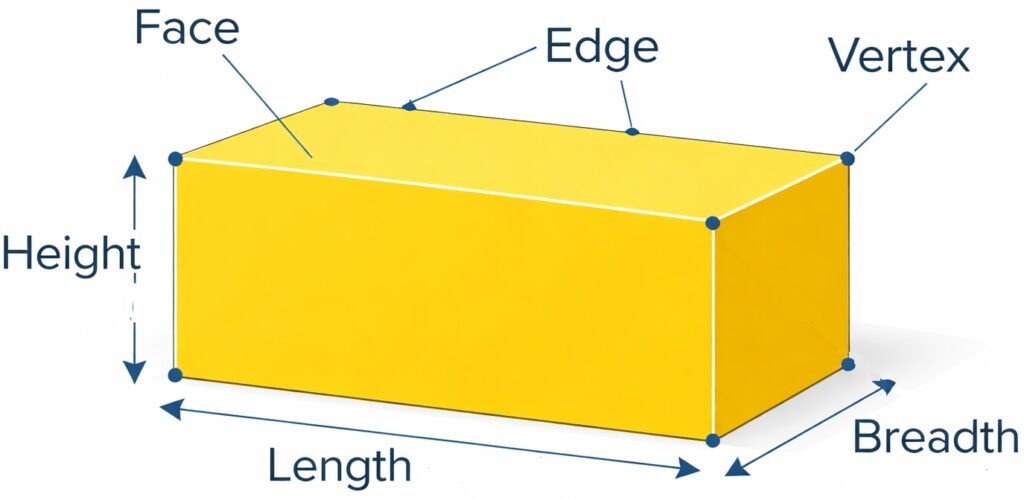
A cuboid is a 3D geometric shape with six rectangular faces, twelve edges, and eight vertices, resembling a box.
A cuboid has three different dimensions:
Length
Breadth
Height
Formula
Volume of cuboid = Length × Breadth × Height
Example
Length = 8 cm
Breadth = 5 cm
Height = 3 cm
Volume = 8 × 5 × 3
= 120 cm³
So, the volume of the cuboid is 120 cubic centimetres.