
The Wonderful World of Science Class 6 Worksheet
Science is a fascinating subject that helps us understand the world around us. From a very young age, we are naturally curious and ask questions about everything we see. Science builds on this curiosity and teaches us how to find answers through observation, thinking, and experiments. It is not just a subject but a way of exploring and understanding nature and the universe.
Everything around us—plants, animals, water, air, and even outer space—is a part of science. Whether it is watching a seed grow into a plant, understanding why it rains, or observing the stars in the sky, science helps us explain these wonders. It connects different ideas and shows how they are related to each other.
One of the most important parts of science is the scientific method, which involves observing, asking questions, making guesses (hypotheses), testing them, and analyzing the results. This method helps us solve problems in daily life.
Science is everywhere and is used by everyone, even in simple activities like cooking or repairing things. Learning science helps us become better thinkers, problem-solvers, and responsible individuals who care for the environment.
This the wonderful world of science class 6 worksheet is designed to help students understand basic concepts like observation, curiosity, and the scientific method in a simple and engaging way. Regular practice with worksheets not only improves concept clarity but also builds confidence for school exams.
All worksheets are carefully created as per the latest CBSE syllabus, making them reliable for both parents and teachers. Each worksheet comes in an easy-to-download PDF format, so students can practice anytime, anywhere. Answers are also provided for quick self-checking and better understanding of mistakes.
At CBSEClassWorksheets, we focus on creating student-friendly worksheets that make learning easy, interactive, and effective for Class 6 Science learners.
Other Class 6 Worksheets
The Steps Followed in the Scientific Process
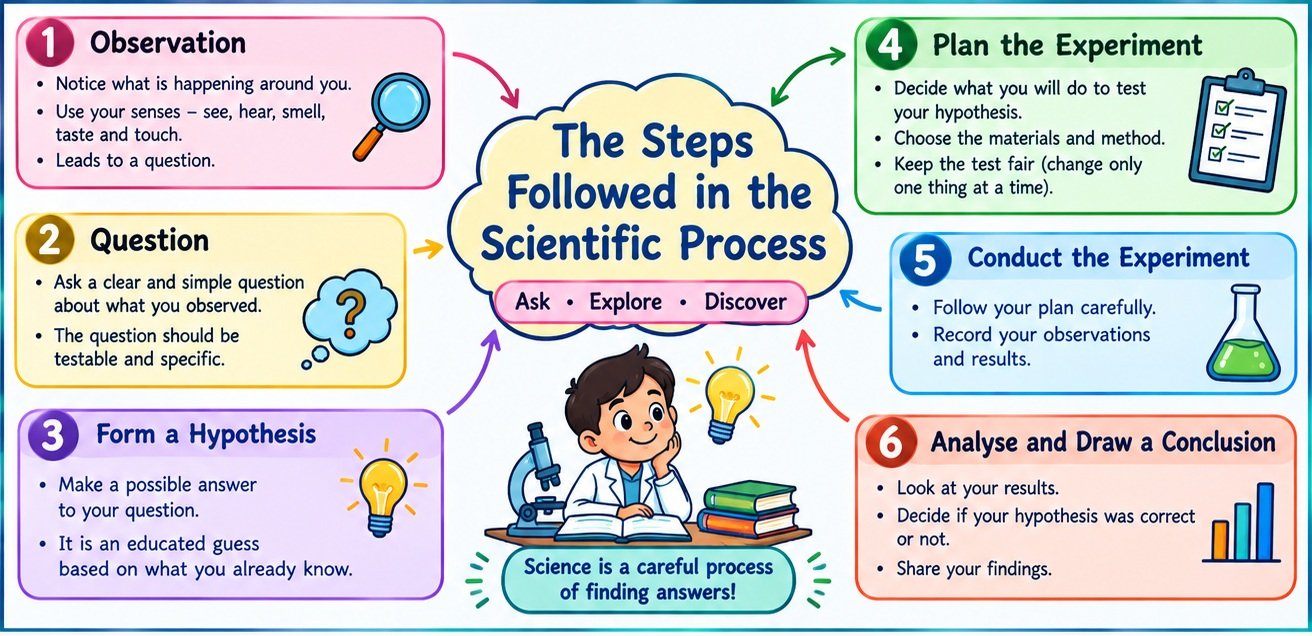
1. Observation
- Observation is the first step in the scientific process.
- It means carefully noticing something happening around us.
- We can make observations using our senses and by using suitable instruments.
- Observation helps us notice a pattern, problem, change or interesting fact.
- A good observation often makes us curious and encourages us to ask questions.
Example:
We notice that a plant kept near sunlight appears to grow differently from a plant kept away from sunlight.
2. Asking a Question
- After making an observation, we ask a clear question about what we observed.
- The question should be:
- Clear
- Specific
- Related to the observation
- Possible to investigate or test
Example:
“Does sunlight affect the growth of a plant?”
3. Forming a Hypothesis
- A hypothesis is a possible answer or explanation for the question.
- It is based on what we already know or have observed.
- A hypothesis can be tested through an experiment.
- The hypothesis may be supported or rejected after studying the results.
Example:
“If a plant receives sunlight, then it will grow better.”
4. Planning the Experiment
- We then plan an experiment to test the hypothesis.
- Decide:
- What materials are needed.
- What steps will be followed.
- What observations or measurements will be recorded.
- The experiment should be conducted carefully and fairly.
- As far as possible, only the factor being investigated should be changed.
Example:
Keep two similar plants under similar conditions, but give one sunlight and keep the other away from sunlight.
5. Conducting the Experiment
- Carry out the experiment according to the plan.
- Observe what happens carefully.
- Take measurements wherever required.
- Record observations and results accurately.
- Repeated observations can make the results more reliable.
Example:
Measure and record the height of both plants over several days.
6. Analysing the Results
- After completing the experiment, study the observations and measurements collected.
- Compare the results.
- Look for patterns or changes.
- Think about what the results tell us about the question.
Example:
Compare the growth of the plant kept in sunlight with the plant kept away from sunlight.
7. Drawing a Conclusion
- A conclusion is the final statement based on the results of the experiment.
- Decide whether the results support the hypothesis or not.
- The conclusion should be based on evidence and observations, rather than on guesses.
Example:
If the plant receiving sunlight grows better, the results support the hypothesis that sunlight affects plant growth.
8. Sharing the Findings
- Scientists communicate their observations, methods, results and conclusions to others.
- Sharing findings allows other people to understand, discuss and learn from the work.
- Scientific research often involves teamwork, where people combine their knowledge, expertise and resources.