
Class 6 Oceans and Continents Worksheet Question Answer
Chapter 2 of the CBSE Class 6 Social Science textbook, Oceans and Continents, introduces young learners to the two most important physical features of our planet — the vast oceans that cover almost three-fourths of the Earth’s surface, and the seven continents that make up the remaining landmass. Students explore the five oceans (Pacific, Atlantic, Indian, Southern and Arctic), learn how continents can be counted in different ways, and discover the deep connection between oceans, climate and human life — from monsoon rains and tsunamis to marine biodiversity and ocean pollution.
To help students revise this chapter thoroughly, our class 6 oceans and continents worksheet collection at cbseclassworksheets.com offers a complete, exam-ready practice pack. Each oceans and continents worksheet class 6 set includes multiple choice questions, fill in the blanks, true/false statements, short-answer questions and short notes, along with oceans and continents class 6 questions and answers for quick self-checking. We have also created dedicated case-study based and picture-based worksheets so that every common exam question format is covered.
Whether you are looking for a class 6 sst chapter 2 oceans and continents worksheet to use in the classroom, for homework, or for last-minute revision before exams, these downloadable Word documents are designed to match the CBSE Class 6 syllabus exactly, with clear explanations and complete answer keys. Explore more chapter-wise worksheets for all subjects on our homepage at cbseclassworksheets.com, and make exam preparation simpler, one chapter at a time.
Class 6 Social Science Worksheets
- Locating Places On Earth
- Landforms and Life
- Timeline and Sources of History
- India, That Is Bharat
- The Beginnings of Indian Civilisation
- India’s Cultural Roots
- Unity in Diversity, or ‘Many in the One’
- Family and Community
- Grassroots Democracy – Part 1: Governance
- Grassroots Democracy – Part 2: Local Government in Rural Areas
- Grassroots Democracy – Part 3: Local Government in Urban Areas
- The Value of Work
- Economic Activities Around Us
CBSE Classes
Oceans and Disasters
- Oceans cover almost three-fourths of the Earth’s surface, making Earth appear like a “blue planet.”
- Oceans play an important role in bringing rain to the continents.
- The monsoon rains received in India during summer originate in the oceans.
- Without ocean-based rainfall, agriculture and other forms of life would suffer.
- However, oceans can also cause natural disasters.
- Storms and cyclones can bring very strong winds and heavy rainfall.
- Cyclones can cause widespread damage, especially in coastal regions.
- A tsunami is a huge and powerful wave that generally originates in the ocean.
- Tsunamis are usually caused by a strong earthquake or volcanic eruption at the bottom of the ocean.
- Tsunamis can travel thousands of kilometres and submerge coastal areas.
- The 2004 Indian Ocean tsunami severely affected the Andaman and Nicobar Islands and parts of the coasts of Tamil Nadu and Kerala.
- Countries work together through early warning systems to detect tsunamis and protect lives and property.
- India participates in the Indian Ocean Tsunami Warning System.
- Events causing loss of life and property are dealt with through disaster management.
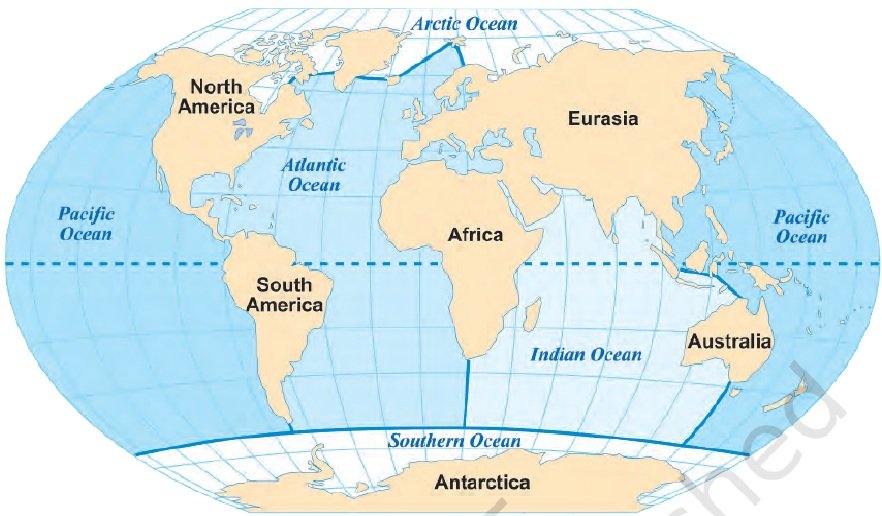
Continents
- A continent is a large, continuous expanse of land.
- Continents are large landmasses surrounded by oceans and seas.
- The number of continents can vary depending on how landmasses are grouped.
- The chapter explains that continents can be counted as four, five, six or seven.
- North America and South America are generally considered two continents, but together they can also be considered one landmass called America.
- Europe and Asia are generally considered two continents.
- Geologists often consider Europe and Asia as one continent called Eurasia.
- Africa and Eurasia may also sometimes be considered together.
- The seven continents most commonly used are:
- Asia
- Africa
- North America
- South America
- Antarctica
- Europe
- Australia
- The seven-continent model is the one most widely adopted and used.
- The Northern Hemisphere has more land than the Southern Hemisphere.
Seven Continents — Quick Revision
| Continent | Key point |
|---|---|
| Asia | The largest continent |
| Africa | One of the major continents |
| North America | One of the two American continents |
| South America | One of the two American continents |
| Antarctica | The coldest continent |
| Europe | Historically and culturally distinct from Asia |
| Australia | The smallest continent |