
Materials Around Us Class 6 Worksheet, Questions and Answer
Welcome to the materials around us class 6 worksheet collection, designed to help every CBSE student build a strong foundation in one of the most practical chapters of Class 6 Science. This chapter, Materials Around Us, explores the everyday objects around us – from a wooden pencil to a steel spoon – and teaches students how to identify and compare materials based on properties such as hardness, lustre, solubility, transparency, and whether an object floats or sinks in water.
Through this class 6 materials around us worksheet set, students practise sorting everyday materials into meaningful groups, understand why certain materials are chosen for specific uses (like waterproof cloth for umbrellas or hard metal for utensils), and explore fun concepts such as miscible and immiscible liquids. Each worksheet is built to match the CBSE Class 6 syllabus and NCERT learning outcomes exactly, so students revise the right concepts in the right depth before their exams.
This resource includes multiple downloadable worksheet sets covering multiple choice questions, fill in the blanks, true or false, match the following, short answers, short notes, and one-word answer questions, along with dedicated materials around us class 6 questions and answers for case studies and picture-based learning. Every worksheet comes with a complete, teacher-verified answer key so that students and parents can self-check progress at home.
For more subject-wise practice worksheets, sample papers, and chapter notes across all Class 6 subjects, visit our homepage at cbseclassworksheets.com, your one-stop destination for free, high-quality CBSE study material.
Other Class 6 Worksheets
Class 6 Materials Around Us Worksheet, Question & Answer (Free PDF)
More Worksheets on Materials Around Us Class 6 (Questions and Answers)
Classification of Materials
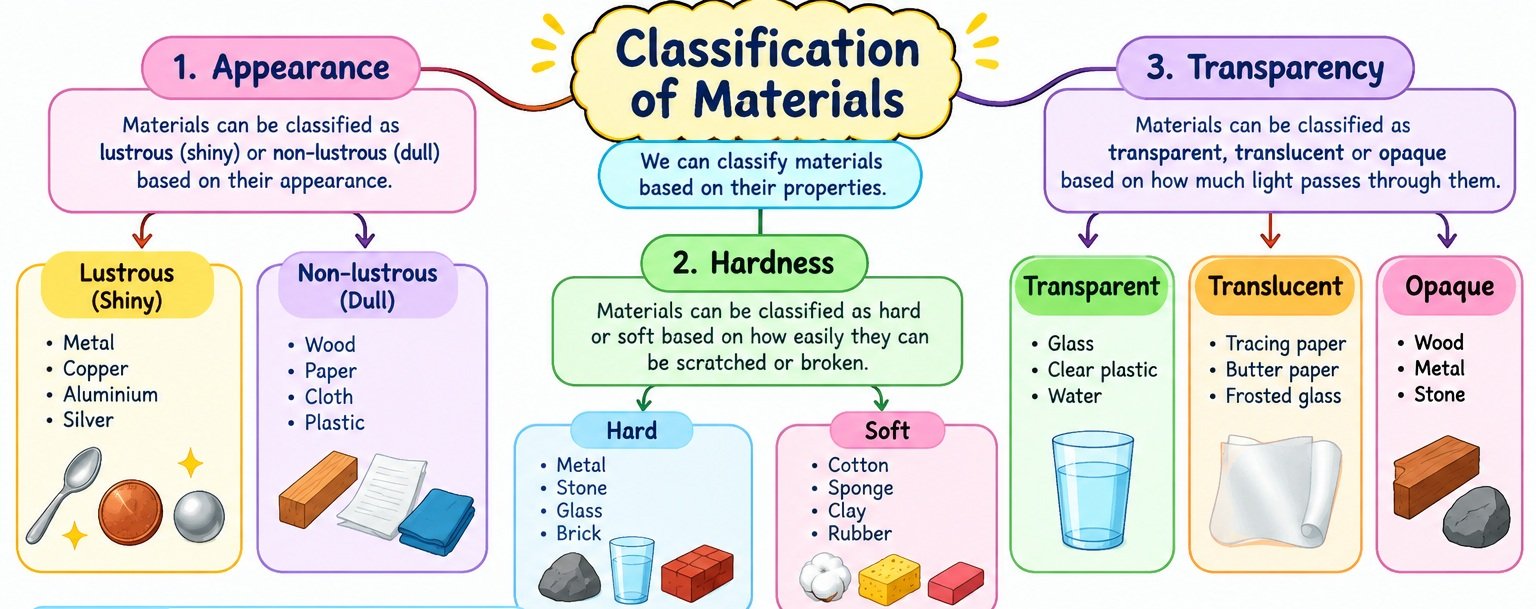
Materials are all around us. Different objects are made from different materials because materials have different properties. We can classify materials by observing their properties. The important properties shown in the chapter material are appearance, hardness, and transparency.
1. Classification Based on Appearance
Materials can be classified according to how they look.
A. Lustrous Materials
- Materials that have a shiny appearance are called lustrous materials.
- They reflect light from their surface.
- Most metals are lustrous.
- Examples: gold, silver, copper and aluminium.
B. Non-Lustrous Materials
- Materials that do not have a shiny appearance are called non-lustrous materials.
- They generally have a dull appearance.
- Examples: wood, paper and cloth.
2. Classification Based on Hardness
Materials can also be classified according to how hard or soft they are.
A. Hard Materials
- Hard materials cannot be easily scratched, pressed, or broken.
- They are generally strong and firm.
- Examples include stone, iron, glass and brick.
- Hard materials are useful for making objects that need strength and durability.
B. Soft Materials
- Soft materials can be pressed, scratched, or compressed more easily.
- Examples include cotton, sponge, clay and rubber.
- Soft materials are useful for making objects that need flexibility or cushioning.
3. Classification Based on Transparency
Materials can be classified according to the amount of light that can pass through them.
There are three main groups:
A. Transparent Materials
- Materials through which we can see clearly are called transparent materials.
- They allow most or all of the light to pass through them.
- Examples: clear glass, clear plastic and clean water.
- Transparent materials are commonly used where clear visibility is required.
B. Translucent Materials
- Materials through which some light can pass, but objects cannot be seen clearly, are called translucent materials.
- They allow only a part of the light to pass through them.
- Examples: butter paper, tracing paper and frosted glass.
C. Opaque Materials
- Materials through which light cannot pass are called opaque materials.
- We cannot see through them.
- Examples: wood, metal and stone.
4. Why Do We Classify Materials?
- Classification makes it easier to study and identify materials.
- It helps us understand the different properties of materials.
- We can select a suitable material for a particular purpose.
- For example, glass is suitable for windows because it is transparent.
- Metal is suitable for many strong objects because it is hard.
- Cotton is useful for making soft clothing.
- Thus, knowing the properties of materials helps us choose the right material for the right purpose.