
Class 6 Chapter 5 Science Worksheet - Measurement of Length and Motion Worksheet
Looking for a reliable class 6 Chapter 5 science worksheet? Chapter 5 of the NCERT Curiosity science textbook, Measurement of Length and Motion, begins with Deepa, who visits a cloth shop and a tailor and wonders how length is measured. Through the story, students learn why body-based units like the handspan, foot and angula give different results for different people, and why the world uses standard units.
In this chapter, children learn that the SI unit of length is the metre (m), and that 1 km = 1000 m, 1 m = 100 cm and 1 cm = 10 mm. They practise the correct way of measuring length by placing the scale in contact with the object and keeping the eye directly above the mark. They also learn to use a scale with broken ends and to measure a curved line with a thread or flexible tape.
The second half of the chapter explains the reference point and shows that an object is in motion when its position changes with respect to that point with time. Students then explore linear motion, circular motion and oscillatory motion, and understand periodic motion through swings, merry-go-rounds and vibrating strips.
Our measurement of length and motion worksheet set has MCQs, fill in the blanks, true or false, match the following, short answers, case study questions and picture-based questions. Every measurement class 6 worksheet with answers comes with a full answer key so that students can check their work. Explore more free CBSE practice sheets for every subject on our homepage, cbseclassworksheets.com.
Class 6 Science Worksheets
- Wonderful World of Science
- Diversity in the Living World
- Mindful Eating: A Path to a Healthy Body
- Exploring Magnets
- Measurement of Length and Motion
- Materials Around Us
- Temperature and its Measurement
- A Journey Through States of Water
- Methods of Separation in Everyday Life
- Living Creature: Exploring their Characteristics
- Nature's Treasures
CBSE Classes
Measurement of Length and Motion worksheet, Question & Answer (Free PDF)
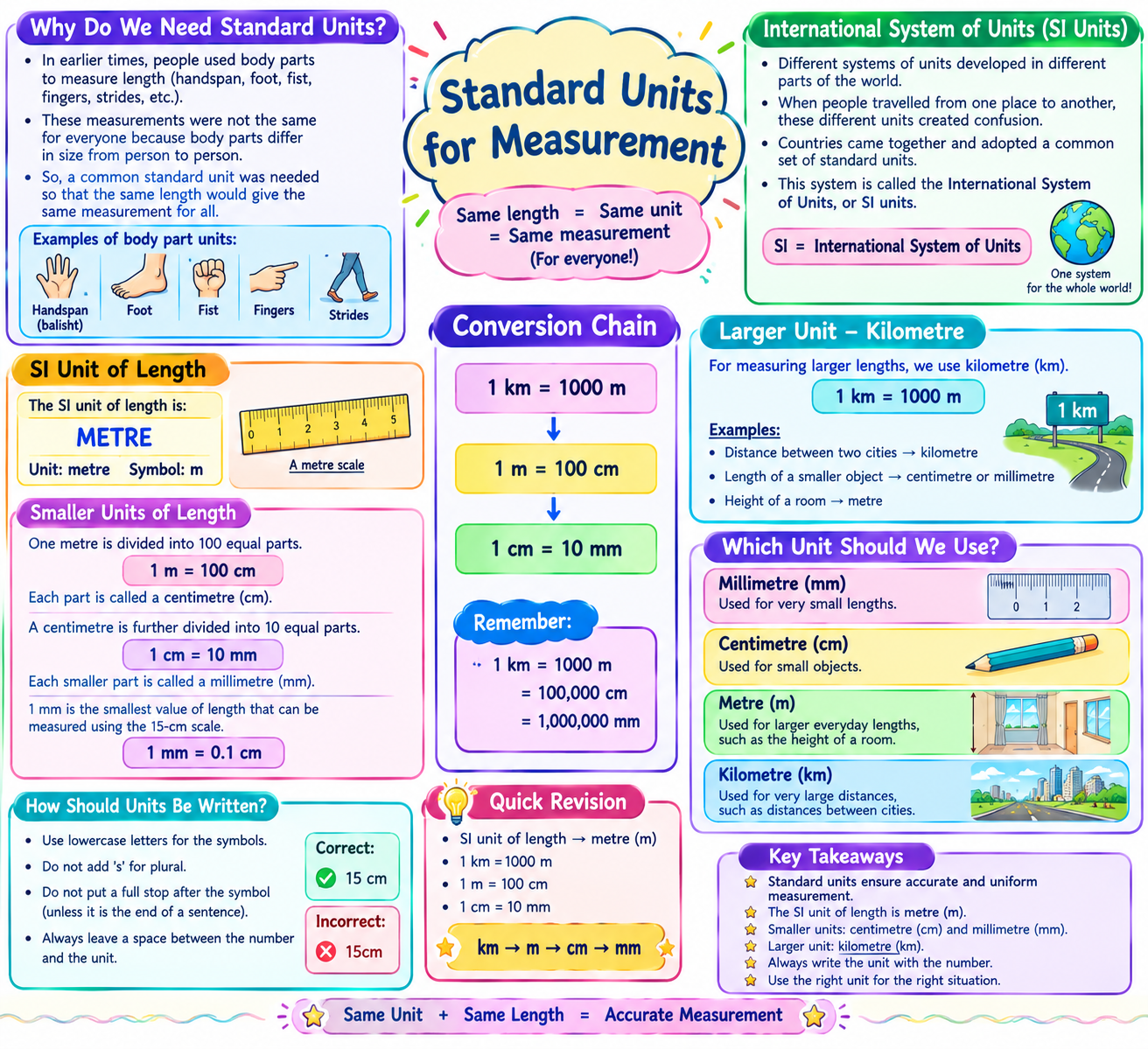
Why Do We Need Standard Units?
- In earlier times, people used body parts to measure length.
- Examples included:
- Handspan or balisht
- Length of the hand
- Foot
- Fist
- Fingers
- Strides
- These measurements were not the same for everyone because body parts differ in size from person to person.
- For example, when students measured the same table using their handspans, they got different results.
- Therefore, there was a need for a common standard unit so that the same length would give the same measurement for different people.
International System of Units – SI Units
- Different systems of units developed in different parts of the world.
- When people travelled from one place to another, different units created confusion.
- Countries therefore came together and adopted a common set of standard units.
- This system is called the International System of Units, or SI units.
⭐ Remember
SI = International System of Units
What is Motion? What are the Types of Motion?
What is Motion?
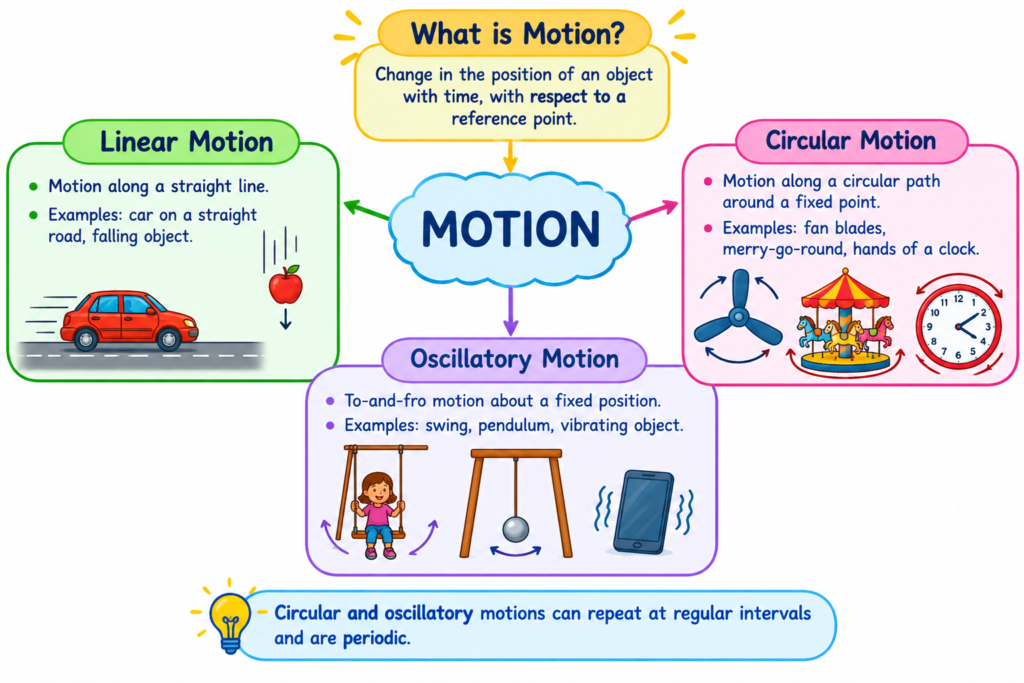
- Motion is a change in the position of an object with time.
- To decide whether an object is moving, we compare its position with respect to a fixed reference point.
- For example, a car moving along a road changes its position with time, so it is in motion.
- An object that does not change its position with respect to a reference point is said to be at rest.
- Whether an object is at rest or in motion depends on the reference point used.
Reference Point
- A reference point is a fixed point used to describe the position or movement of an object.
- For example, a tree, a building, or a lamp post can be used as a reference point.
- If the position of an object changes with respect to the reference point, the object is in motion.
Types of Motion
Linear Motion
- Linear motion is the motion of an object along a straight line or a nearly straight path.
- The object changes its position along a straight path.
- Examples: a car moving on a straight road, a person walking along a straight path, and a falling object.
- Key idea: Linear motion → straight-line path.
Circular Motion
- Circular motion is the motion of an object along a circular path around a fixed point or centre.
- The direction of motion keeps changing as the object moves around the circle.
- Examples: blades of a ceiling fan, hands of a clock, and a merry-go-round.
- Key idea: Circular motion → circular path.
Oscillatory Motion
- Oscillatory motion is a repeated to-and-fro motion of an object about a fixed position.
- The object moves on either side of a central or mean position.
- Examples: a child on a swing, a pendulum moving to and fro, and a vibrating object.
- Key idea: Oscillatory motion → to-and-fro motion.
Periodic Motion
- A motion that repeats itself after equal intervals of time is called periodic motion.
- Circular and oscillatory motions can be periodic when they repeat regularly.
- Examples include the regular movement of a pendulum and the hands of a clock.
Quick Revision Table
Type of Motion | Path / Movement | Example |
Linear | Straight line | Car on a straight road |
Circular | Circular path | Fan blade / clock hand |
Oscillatory | To and fro | Swing / pendulum |
Periodic | Repeats at regular intervals | Regular pendulum motion |