CBSE Class 1 Syllabus: A Complete Guide for Parents
Your child is starting — or already in — Class 1, and suddenly you’re hearing new terms like “Foundational Stage,” “Mridang,” and “NCF 2023.” If you’re wondering exactly what your six-year-old will study this year, you’re not alone. Thousands of Indian parents search for the CBSE syllabus for Class 1 every academic session, and this year’s search is a little more urgent because the curriculum itself has changed under NEP 2020.
What is the CBSE Class 1 syllabus?
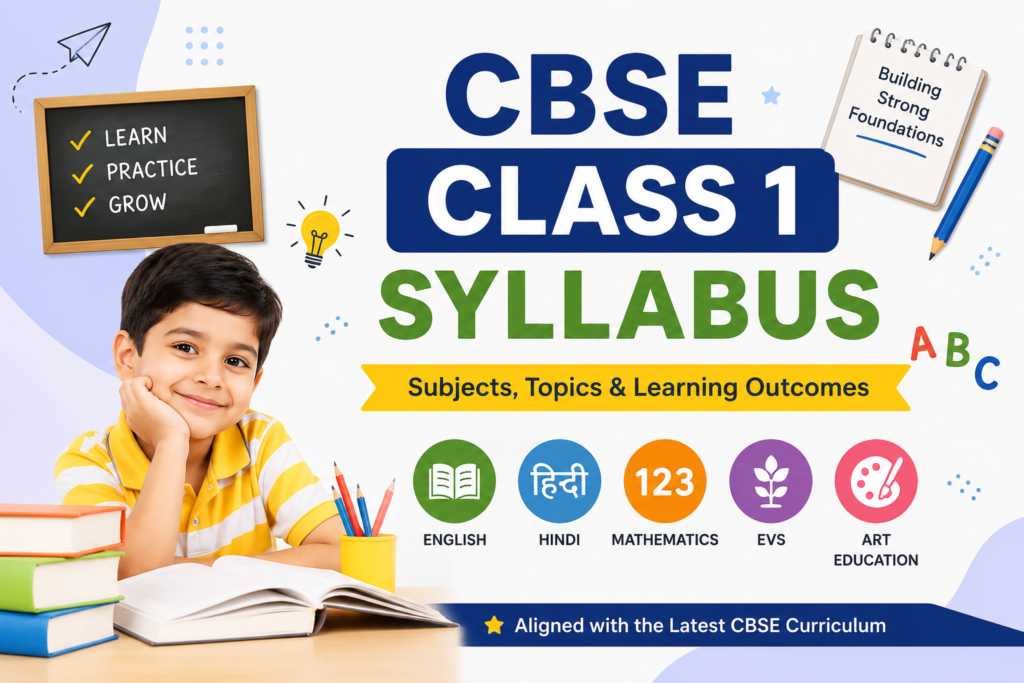
The CBSE Class 1 syllabus for 2026–27 is a NEP 2020-aligned, activity-based curriculum covering English, Hindi, Mathematics, Environmental Studies (EVS), General Knowledge, Art Education, and Health & Physical Education. It uses three core NCERT textbooks — Mridang (English), Sarangi (Hindi), and Joyful Mathematics (Maths) — and focuses on play-based, experiential learning rather than exams or rote memorisation.
This guide breaks down every subject, learning outcome, and assessment pattern for the year, compares it with the earlier curriculum, and gives you practical, no-pressure ways to support your child at home.
Why Understanding the Syllabus Matters for Parents
Class 1 is often a child’s first real academic year, and parental anxiety at this stage is completely normal. Knowing the syllabus helps you:
- Track what’s being taught each term without depending solely on the school diary
- Reinforce classroom learning at home in the right sequence
- Spot learning gaps early, when they’re easiest to fix
- Choose the right supplementary books and activities
Feel confident during Parent-Teacher Meetings
How NEP 2020 Transformed Class 1 Education
The National Education Policy (NEP) 2020, implemented through the National Curriculum Framework for the Foundational Stage (NCF-FS), has reshaped early schooling. Class 1 is no longer about copying alphabets and memorising tables — it’s about building number sense, oral language, and curiosity through stories, games, and hands-on activities.
Detailed CBSE Class 1 English Syllabus
The CBSE Class 1 English syllabus focuses on foundational language skills through play-based learning and storytelling. It uses the NCERT Mridang textbook, covering reading comprehension, basic grammar, listening, and speaking. Formal written exams are typically replaced with oral and activity-based assessments. The syllabus is divided into four thematic units — My Family and Me, Life Around Us, Food, and Seasons — that blend stories, poems, and picture-based tasks.
Reading Skills
Children learn letter-sound recognition, blend simple words, and “read” pictures before moving to short sentences and rhymes.
Writing Skills
Focus is on simple sentence formation, copying basic words, and basic punctuation.
Speaking & Listening
Daily oral activities include poem recitation, “show and tell,” picture description, and guided classroom conversation.
Grammar Concepts
Introduction to nouns, pronouns, verbs, adjectives, simple tenses, and the use of articles (‘a’ and ‘an’). There is no separate grammar book.
Detailed CBSE Class 1 Hindi Syllabus
The CBSE Class 1 Hindi syllabus is based on the NCERT textbook ‘Sarangi’ . It mainly coversIncludes alphabets, barakhadi, simple words, simple poems and things, which will increase students’ enjoyment of the language.
Reading (Swar, Vyanjan, Matra, Simple Words)
Children revise vowels (स्वर) and consonants (व्यंजन), then move into simple matras and two-to-three-letter words.
Writing (Letter Formation, Copy Writing, Dictation)
Practice includes tracing, copy-writing of letters and words, and short, teacher-led dictation of familiar words.
Speaking & Listening (Poems, Rhymes, Conversation)
Poems, rhymes, and short stories drawn from festivals and daily life build fluency and confidence in spoken Hindi.
Grammar Foundations
Hindi grammar section teaches the students the basics and foundation of tenses, gender, word-building, and conversation.
Detailed CBSE Class 1 Mathematics Syllabus
Maths in 2026–27 follows NCERT Joyful Mathematics, a text-cum-workbook of 13 chapters plus a puzzles section, replacing the earlier Math-Magic book and its unit-wise format.
Topic | What Your Child Learns | Learning Outcome |
Numbers (0–100) | Counting, number names, before/after, comparing | Reads, writes, and orders numbers confidently |
Addition & Subtraction | Single-digit sums, simple word problems | Solves everyday problems using objects and pictures |
Shapes & Spatial Understanding | Basic 2D shapes, spatial words (near, far, inside) | Identifies and sorts shapes in daily surroundings |
Measurement | Length, weight, time (before/after, days) | Compares length/weight; reads simple time concepts |
Data Handling | Sorting, classifying, simple pictographs | Groups objects by colour, size, or type |
Mental Math & Patterns | Number patterns, quick recall, money basics | Recognises and extends simple patterns |
Concepts move from concrete → pictorial → abstract, so a child first handles real objects, then works with pictures, and only later with numerals and symbols — no early abstract memorisation.
Detailed CBSE Class 1 Environmental Studies (EVS) Syllabus
EVS in Class 1 has no separate NCERT textbook; it is woven into English, Hindi, and Maths lessons and delivered through classroom activities and themes such as:
- About Myself – family members, body parts, sense organs, feelings
- Plants and Animals Around Us – common plants, pets, farm and wild animals
- Food, Water, and Shelter – healthy food habits, sources of water, types of homes
- Our Surroundings – home, classroom, neighbourhood, helpers around us
- Good Habits and Safety – cleanliness, road safety, basic first response
- Weather and Seasons – seasonal changes, appropriate clothing, festivals linked to seasons
Co-Scholastic Areas in CBSE Class 1
These “non-academic” subjects are just as important for holistic development under NEP 2020.
Art and Craft (Drawing, Coloring, Paper Work)
Free drawing, colouring within lines, tearing-and-pasting, and simple paper craft build fine motor control and creativity.
Music and Dance
Rhymes, simple rhythm activities, and basic movement-based dance build listening skills and coordination.
Physical Education (Basic Motor Skills, Games)
Running, jumping, ball games, and simple yoga asanas develop gross motor skills and discipline.
Health and Wellness
Lessons on hygiene, hand-washing, healthy eating, and adequate sleep are reinforced regularly through classroom routines.
Values Education and Life Skills
Sharing, turn-taking, saying please/thank you, and basic emotional expression are nurtured through stories and group play.
CBSE Class 1 Syllabus vs. Other Boards
Feature | CBSE | ICSE | State Boards | IB PYP / Cambridge Primary |
Curriculum body | NCERT/CBSE | CISCE | State education boards | IB/Cambridge International |
Approach | NEP 2020-aligned, activity-based | Detailed, language-heavy | Varies by state, often exam-oriented | Inquiry-based, concept-driven |
Assessment | Continuous, no formal exams | School-based tests | Often includes periodic tests | Portfolio and inquiry-based |
Language focus | English + Hindi + regional/third language | Strong English emphasis | Regional language emphasis | English-medium, flexible additional languages |
Best suited for | Families wanting a nationally recognised, transferable curriculum | Families prioritising strong language/writing foundations | Families rooted in a specific state system | Families seeking an international, transferable curriculum |
Conclusion: Give Your Child a Confident Start to Class 1
The CBSE Class 1 syllabus for 2026–27 isn’t about exams or pressure — it’s about building strong foundations in reading, number sense, and curiosity, one playful activity at a time. As a parent, the most valuable thing you can offer isn’t perfection; it’s consistent, low-pressure support at home that mirrors what your child is already experiencing in the classroom.
That’s exactly where CBSEClassWorksheets can help. Our worksheets are designed to match the NEP 2020 Class 1 curriculum. Instead of guessing what to revise, you get ready-made, teacher-approved worksheets that keep your child’s home learning perfectly in sync with school. Explore free and printable Class 1 worksheets across English, Hindi, Maths, and EVS — organised term-wise, so you always know exactly what to practise next. Give your child’s Foundational Stage journey the head start it deserves, one worksheet at a time.
Frequently Asked Questions (FAQ)
What subjects are taught in CBSE Class 1?
English, Hindi, Mathematics, Environmental Studies (EVS), General Knowledge, Art Education, and Health & Physical Education.
Is there a final exam in CBSE Class 1?
No. CBSE does not conduct formal board or year-end exams at the Foundational Stage. Assessment is continuous and observation-based, using classroom activities, oral tasks, and simple worksheets.
What if my child finds the Class 1 syllabus difficult?
This is common and usually not a cause for worry. Talk to the class teacher, reinforce concepts through play at home, and give it time — the Foundational Stage is designed to build confidence gradually, not to test children.
Is Sanskrit taught in CBSE Class 1?
Sanskrit is not a standard Class 1 subject under CBSE; the third-language requirement typically applies from later classes, depending on school policy.
Which NCERT books are used in Class 1 CBSE?
Mridang for English, Sarangi for Hindi, and Joyful Mathematics for Mathematics — all reprinted for 2026–27 under the NCF-FS framework.