
Temperature and Its Measurement Class 6 Questions and Answers - Science Chapter 7
Welcome to the cbseclassworksheets.com page for temperature and its measurement class 6 questions and answers. This chapter of the CBSE Class 6 Science textbook (Curiosity) teaches how we can measure how hot or cold a body is. It begins with the story of Lambok and Phiban and an activity showing that our sense of touch can mislead us, which is why we need a reliable measure called temperature.
Students learn that a device that measures temperature is called a thermometer. A clinical thermometer measures human body temperature and today is usually a digital thermometer that uses heat sensors. A laboratory thermometer has a glass tube, a bulb and a liquid column, and a typical range of –10 °C to 110 °C. The chapter also explains the Celsius scale, the Fahrenheit scale and the Kelvin scale, the SI unit kelvin, and the normal body temperature of 37.0 °C (98.6 °F).
Children also learn the correct way to read a thermometer, how to find its range and smallest value, how air temperature is reported in weather forecasts, and the contribution of Anna Mani, the “Weather Woman of India”.
To practise, download our free temperature and its measurement class 6 worksheet sets with MCQs, fill in the blanks, true or false, match the following, short notes, case study questions and picture-based questions – all with answers. Each Temperature and its Measurement worksheet follows the NCERT pattern, so it is ideal for homework, revision and exam preparation. Explore more chapters on the cbseclassworksheets.com homepage.
Class 6 Science Worksheets
- Wonderful World of Science
- Diversity in the Living World
- Mindful Eating: A Path to a Healthy Body
- Exploring Magnets
- Measurement of Length and Motion
- Materials Around Us
- A Journey Through States of Water
- Methods of Separation in Everyday Life
- Living Creature: Exploring their Characteristics
- Nature's Treasures
CBSE Classes
Science Chapter 7 - Temperature and Its Measurement Class 6 Worksheet (Free PDF)
More Temperature and its Measurement Worksheet with Answers
Temperature and Its Measurement Class 6 Questions and Answers
What is a thermometer? What are the kinds of thermometer?
Temperature is a reliable measure of how hot or cold a body is. A hotter body has a higher temperature than a colder body. A device that measures temperature is called a thermometer.
The chapter introduces these kinds of thermometers:
- Clinical thermometer: used to measure human body temperature.
- Laboratory thermometer: used for many other purposes, such as measuring the temperature of liquids in experiments.
- Digital clinical thermometer: shows the temperature as numbers on a display and uses heat sensors.
- Infrared (non-contact) thermometer: measures a person’s temperature without touching the body.
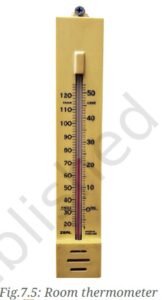
- Room thermometer: gives an approximate idea of room temperature.
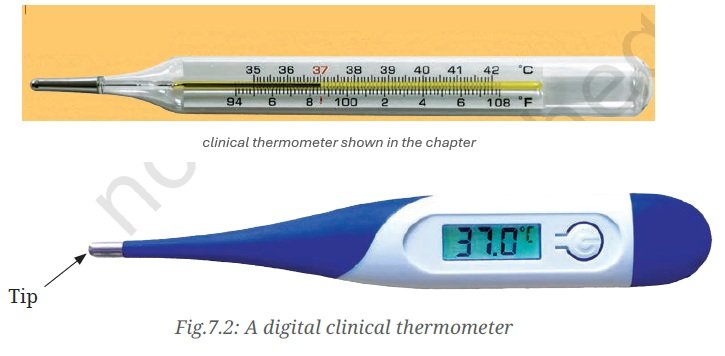
Measuring Temperature Using a Clinical Thermometer
The chapter describes using a digital clinical thermometer as follows:
- Wash your hands and wash the tip of the thermometer with soap and water.
- Reset the thermometer using its reset button, if it has one.
- Place the tip under the tongue and close your mouth.
- Wait until the thermometer beeps or flashes a light.
- Remove it and read the temperature on the digital display.
- Record the reading, then clean and dry the tip again.
The Celsius scale is generally used. Its unit is degree Celsius (°C). The normal temperature of a healthy human adult is taken to be about 37.0 °C or 98.6 °F. A person’s normal temperature may vary slightly.
Measuring Temperature Using a Laboratory Thermometer
A laboratory thermometer usually has a long, narrow, sealed glass tube. A bulb at one end contains a liquid. The liquid column rises or falls as temperature changes. Read the mark on the scale that matches the top of the liquid column.
Correct method
- Put warm water in a beaker and immerse the thermometer bulb in the water.
- Keep the bulb from touching the bottom or sides of the beaker.
- Hold the thermometer vertically; do not tilt it.
- Wait until the liquid column stops rising.
- Read the temperature while the thermometer is still immersed in the water.
- Keep your eye directly in line with the top of the liquid column.

Air Temperature
Room thermometers that are hung on walls in places such as schools, clinics and hospitals. They give an approximate idea of room temperature.
- Weather reports often give the maximum and minimum air temperatures for the day.
- Air temperature usually varies from day to day because weather depends on several factors.
Air temperature is monitored at weather stations and is used, along with other information, to prepare weather forecasts.
Scales of Temperature
The three commonly used temperature scales in the chapter are:
Scale | Unit and symbol | Important point |
Celsius | degree Celsius (°C) | Generally used for clinical thermometer readings. |
Fahrenheit | degree Fahrenheit (°F) | 37.0 °C is equivalent to 98.6 °F. |
Kelvin | kelvin (K) | The SI unit of temperature; do not write a degree sign before K. |
Conversion from Celsius to Kelvin:
Temperature in K = Temperature in °C + 273.15
Example: 37.0 °C = 98.6 °F. When writing a temperature, leave a space between the number and the unit, for example, 25 °C.
Precautions While Using a Clinical Thermometer
- Read the instruction manual before using the thermometer.
- Wash the tip with soap and water before and after use.
- Keep the digital display/electronic portion out of water while washing.
- Do not hold the thermometer by its tip.
- Wait for the beep or flashing light before reading the display.
- Handle it carefully and store it safely after cleaning.
Precautions While Using a Laboratory Thermometer
- Handle the glass thermometer carefully; it can break if it strikes a hard object.
- Do not hold it by the bulb.
- Keep the thermometer vertical and do not tilt it.
- When measuring a liquid, make sure the bulb does not touch the bottom or sides of the container.
- Read the temperature while the bulb is still immersed in the liquid.
- Keep your eye level with the top of the liquid column to avoid a wrong reading.
- Check the thermometer’s range and smallest division before using it.